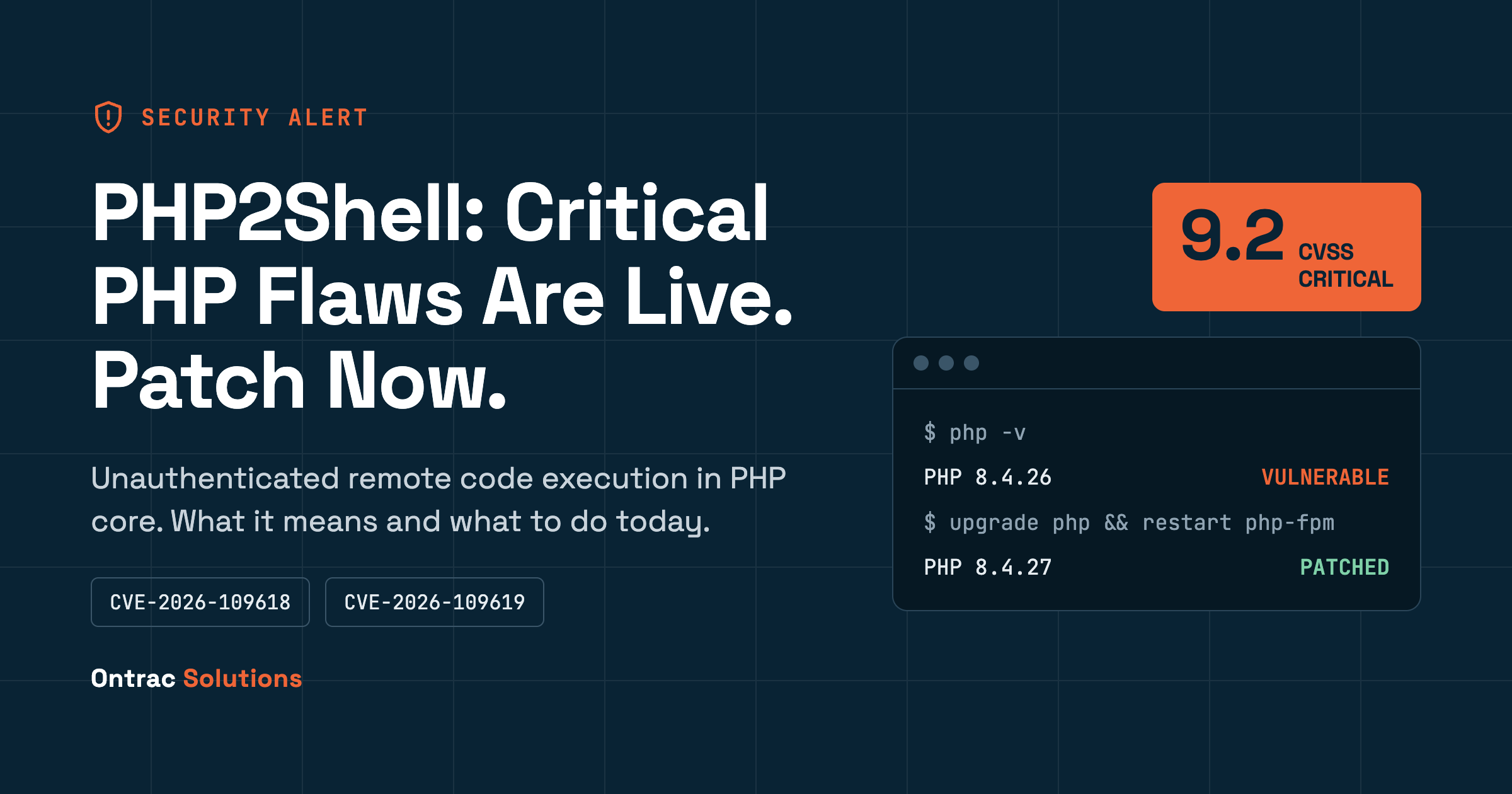
The bottom line: Two critical vulnerabilities in PHP let attackers run code on your web servers without logging in. Patches are out now. If your organization runs WordPress, Drupal, Magento, Laravel or any custom PHP application, treat this as a same-day priority.
What happened
On October 21, 2026, the PHP project released emergency security updates for two vulnerabilities, CVE-2026-109618 and CVE-2026-109619, now being called PHP2Shell. Both carry a CVSS v4.0 severity score of 9.2 out of 10 and allow unauthenticated remote code execution. In plain terms, anyone who can reach a vulnerable PHP application over the internet may be able to take control of the server behind it.
The situation escalated quickly because details leaked before the planned disclosure date. A researcher published alleged technical details and proof-of-concept code online hours after the vulnerabilities surfaced on social media. The Australian Signals Directorate and CERT-EU both issued rare pre-patch alerts, with CERT-EU advising organizations to consider isolating internet-facing applications if they cannot patch immediately.
When working exploit details are public before or at the moment a patch lands, the window between disclosure and attack shrinks from weeks to hours. Security researchers expect mass scanning to begin almost immediately.
Who is affected
PHP sits underneath a huge share of the web, including WordPress, Drupal and Magento, which together run millions of sites. If any part of your digital footprint uses PHP, you are likely in scope:
- Marketing websites and CMS platforms
- Ecommerce storefronts
- Customer and partner portals
- Internal tools and legacy line-of-business applications
- Vendor-hosted or managed applications you may not directly control
PHP 8.1 and older versions, including 7.x and 5.x, will not receive a fix from the PHP project. Those systems need an upgrade, not a patch, and they are the highest-risk assets in most environments.
What to do today
- Inventory every PHP system. Include production, staging, dev servers, container base images and third-party hosted apps. Unknown systems are the ones that get breached.
- Patch supported versions immediately. Update to PHP 8.5.12, 8.4.27, 8.3.36 or 8.2.35, or the equivalent package from your Linux distribution.
- Restart the runtime. PHP-FPM or the web server must be restarted for the patched interpreter to load. A patch that is installed but not running does not protect you.
- Contact your hosting providers. On shared or managed hosting, your provider controls the PHP version. Ask them to confirm in writing that the fixed build is live.
- Isolate what you cannot patch. For end-of-life PHP versions, apply interim mitigations and restrict internet access until the system is upgraded.
- Verify and monitor. Confirm running versions on every host, then review logs for unusual activity since October 20.
Why speed is the whole game
Most organizations do not lose to sophisticated attacks. They lose to the gap between a patch being available and a patch being applied. For a 9.2-severity, no-login-required flaw with public exploit details, that gap is measured in hours. The challenge is rarely knowing what to do. It is having enough skilled hands to do it across every system at once, while the rest of the business keeps running.
How Ontrac helps
Ontrac Solutions provides rapid security and engineering support for organizations that need to move faster than their internal team's bandwidth allows:
- PHP exposure assessment: We identify every PHP asset in your environment, including the ones nobody remembers, and rank them by risk.
- Patching assistance: Our engineers apply, restart and verify updates across your servers, containers and hosting providers.
- Legacy PHP upgrades: For systems stuck on PHP 8.1 or older, we plan and execute the upgrade and resolve the code compatibility issues that usually stall it.
- On-demand engineering capacity: Need extra developers or DevOps engineers this week? Our staff augmentation team can plug into your environment quickly.
Sources: iTnews, Help Net Security, CERT-EU, Tenable. This post reflects information available as of October 21, 2026, and will be updated as details evolve.