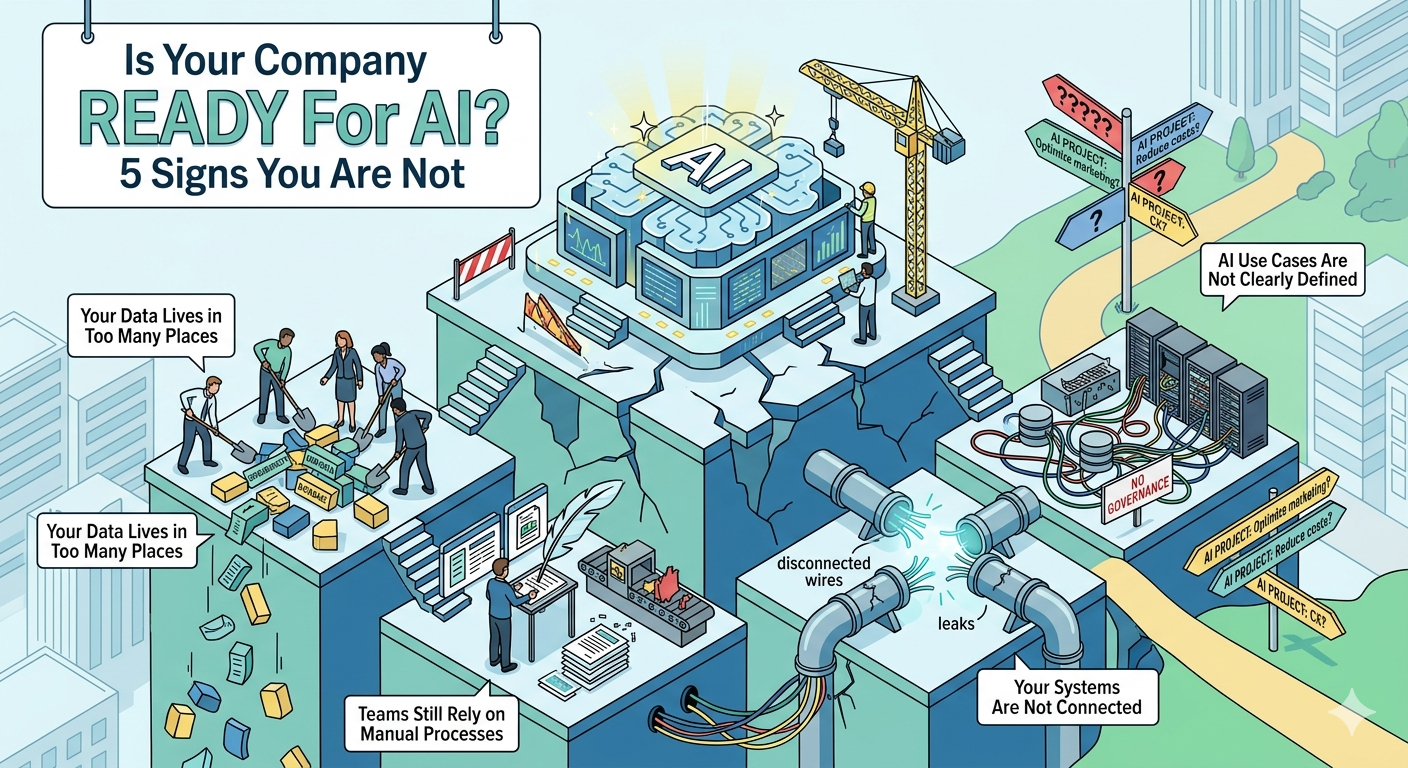
What are the signs a company is not ready for AI?
Five warning signs show a company is not ready for AI: data scattered across too many disconnected places, teams still relying on manual spreadsheet processes, systems that are not connected, no data governance strategy, and no clearly defined AI use cases. Fixing these foundations first separates successful AI adoption from stalled pilots.
Part of our guide: AI Readiness for Mid-Market Enterprises — The 2026 Guide
Artificial intelligence has quickly moved from experimental technology to a boardroom priority.
Executives are asking teams to implement AI across marketing, operations, finance, and customer experience. But many organizations are discovering a difficult reality: implementing AI is much harder than adopting a new software tool.
AI systems depend heavily on clean data, connected systems, and structured workflows. Without those foundations, even the most powerful AI platforms struggle to deliver meaningful results.
If your organization is exploring AI adoption, here are five signs your company may not be fully prepared yet.
1. Your Data Lives in Too Many Places
One of the most common barriers to AI implementation is fragmented data.
Many companies store critical information across multiple platforms such as CRM systems, spreadsheets, analytics tools, and internal databases. When data is scattered across systems, AI tools cannot access a complete view of the business.
Modern AI platforms rely on centralized data infrastructure to generate meaningful insights.
Organizations moving toward AI often start by consolidating their data through modern cloud platforms such as AWS
https://aws.amazon.com/
or Google Cloud
https://cloud.google.com/
2. Teams Still Rely on Manual Processes
If employees spend hours exporting spreadsheets, copying information between tools, or manually compiling reports, your organization likely needs workflow automation before introducing AI.
AI performs best when integrated into automated processes, not manual ones.
Automation tools and integrations should be implemented first so AI can operate within structured workflows.
3. Your Systems Are Not Connected
Disconnected technology stacks create major obstacles for AI initiatives.
When CRM, marketing automation, support systems, and analytics platforms operate in isolation, AI cannot access the full dataset needed to generate accurate insights.
Companies often solve this problem through integrations or unified platforms like HubSpot
https://www.hubspot.com/
that centralize data and customer activity.
4. There Is No Data Governance Strategy
AI systems introduce new challenges around security, compliance, and responsible data usage.
Organizations must define how data is collected, stored, and used before deploying AI tools.
Frameworks such as the NIST AI Risk Management Framework help organizations establish governance structures for AI initiatives.
https://www.nist.gov/itl/ai-risk-management-framework
5. AI Use Cases Are Not Clearly Defined
Some companies pursue AI adoption simply because competitors are doing it.
But successful AI initiatives always begin with specific business problems such as improving customer support response times, optimizing marketing performance, or reducing operational costs.
Without clearly defined use cases, AI projects often stall.
Preparing Your Organization for AI
AI can deliver extraordinary value when implemented correctly. But successful adoption requires a strong foundation.
Organizations that take time to evaluate their infrastructure, workflows, and data environment before implementing AI consistently achieve better outcomes.
An AI Readiness Audit helps organizations identify these gaps and build a roadmap for AI adoption that delivers real business impact.
Keep Reading