AI Readiness Audit: 20-Point Checklist to Know If Your Organization Is Ready
Read Time 7 mins | Written by: Eric Fouarge
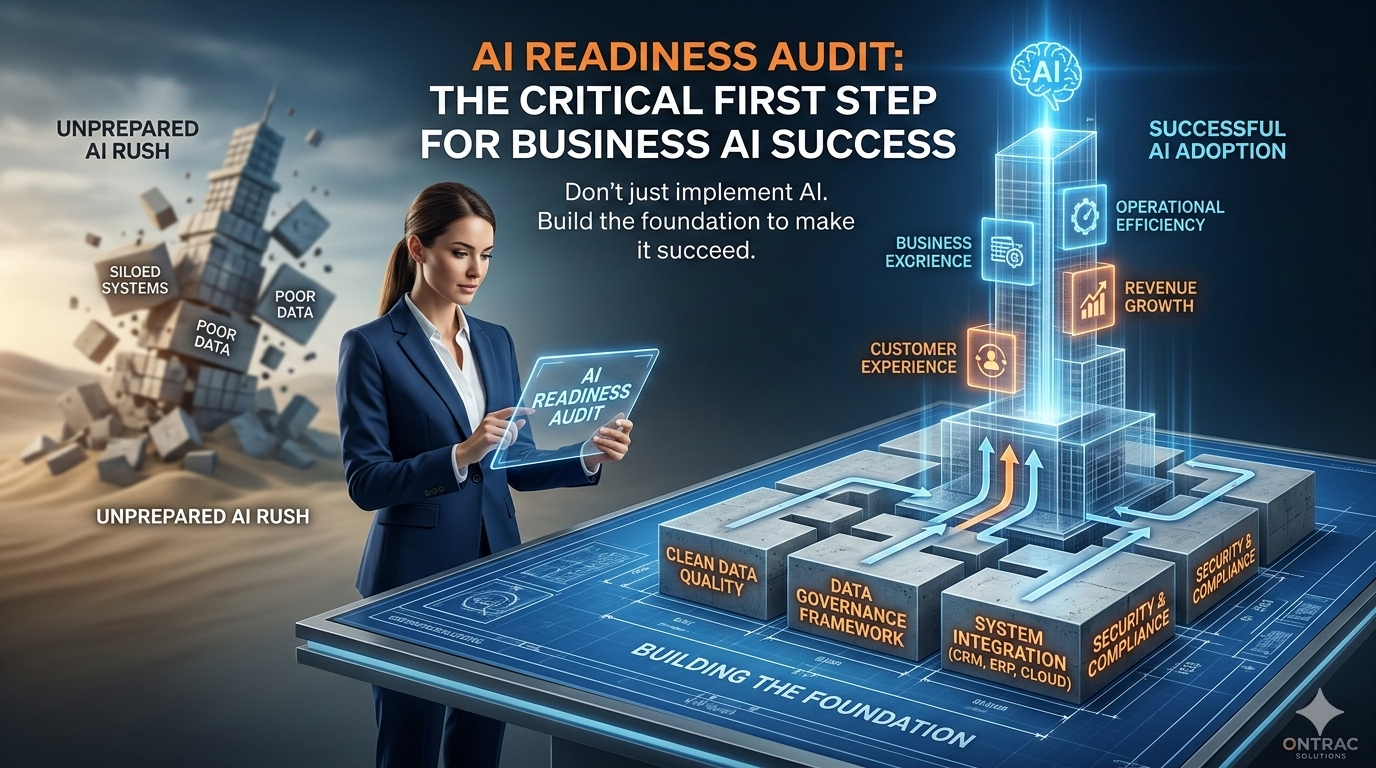
Part of our guide: AI Readiness for Mid-Market Enterprises — The 2026 Guide
What is AI readiness?
AI readiness is a 20-point assessment that scores an organization across data quality, system integration, infrastructure maturity, governance, and use-case prioritization. According to Gartner research, over 85% of AI projects fail to deliver expected value — usually because these foundations are missing. A structured audit surfaces the gaps before deployment, not after.
Artificial intelligence has moved from experimentation to expectation.
Every leadership team is asking the same question: How do we start using AI in our business?
But most companies are skipping a critical step.
They jump straight into tools like ChatGPT, AI copilots, or automation platforms without evaluating whether their data, systems, and infrastructure are ready to support AI at scale.
According to research from Gartner, over 85% of AI projects fail to deliver expected value, often due to poor data quality, lack of governance, or unclear implementation strategies.
Instead of rushing into AI adoption, organizations should start with something far more practical: an AI Readiness Audit.
An audit helps determine whether your company actually has the foundation required to implement AI successfully.
The AI Gold Rush Is Creating Risk for Businesses
Over the last two years, the explosion of generative AI has created enormous pressure on companies to adopt new tools quickly.
Platforms like ChatGPT from OpenAI (https://openai.com/chatgpt) and enterprise copilots such as Microsoft Copilot (https://www.microsoft.com/en-us/microsoft-copilot) have shown how powerful AI can be for productivity, marketing, customer support, and analytics.
But technology alone does not create value.
AI systems depend heavily on the quality, structure, and accessibility of your data.
If your internal systems are disconnected, your data is inconsistent, or your workflows are manual, AI tools will simply amplify existing problems rather than solve them.
This is why organizations that rush into AI without preparation often see disappointing results.
Why Most AI Initiatives Fail
Many companies assume that implementing AI is primarily a technology challenge.
In reality, the biggest obstacles are usually operational and data related.
Some of the most common reasons AI initiatives fail include:
Poor Data Quality
AI models rely on clean, structured data. If your data is fragmented across multiple systems or filled with inconsistencies, AI outputs will be unreliable.
The principle of “garbage in, garbage out” is especially true in AI systems.
Siloed Systems
Many companies operate with disconnected platforms across CRM, marketing automation, customer support, finance, and analytics tools.
When systems cannot communicate with each other, AI cannot access the complete picture needed to generate insights.
Lack of Governance
AI introduces new risks around data security, compliance, and responsible use. Without governance frameworks, companies may expose themselves to regulatory or reputational issues.
The National Institute of Standards and Technology (NIST) has published an AI Risk Management Framework that highlights the importance of governance in AI deployment.
https://www.nist.gov/itl/ai-risk-management-framework
Unclear Use Cases
One of the most common mistakes companies make is adopting AI because it feels urgent rather than because it solves a specific business problem.
AI initiatives work best when tied directly to measurable outcomes such as:
• revenue growth
• operational efficiency
• cost reduction
• customer experience improvements
What an AI Readiness Audit Actually Evaluates
An AI Readiness Audit is designed to evaluate whether your organization has the technical, operational, and data infrastructure required for successful AI adoption.
At a high level, the audit typically focuses on several key areas.
Data Infrastructure
The audit evaluates whether your data is structured, centralized, and accessible.
Key questions include:
• Where is your data stored?
• Is it standardized across systems?
• Can AI tools access it securely?
Organizations that rely heavily on manual spreadsheets or disconnected databases often struggle to implement AI effectively.
Technology Stack
Your existing platforms play a major role in AI readiness.
Modern cloud ecosystems such as AWS, Microsoft Azure, and Google Cloud provide the infrastructure needed to support AI models and automation.
AWS provides a helpful overview of how companies are integrating AI into cloud infrastructure.
https://aws.amazon.com/what-is/artificial-intelligence/
Workflow Automation
Many companies attempt to implement AI before automating their core workflows.
In reality, automation often comes first.
If your teams are still manually moving data between systems, AI will struggle to integrate into your processes.
Security and Compliance
AI systems often interact with sensitive business and customer data.
An audit helps ensure that your organization has the proper security controls and compliance frameworks in place before deploying AI tools.
Organizational Readiness
Technology alone does not drive AI success.
Leadership alignment, team training, and internal processes all play a role in whether AI adoption succeeds.
Signs Your Organization Might Not Be Ready for AI Yet
Many organizations are excited about AI but unknowingly lack the foundation needed to implement it effectively.
Some common warning signs include:
• Teams manually exporting data between systems
• Customer information stored across multiple CRMs or spreadsheets
• No clear ownership of data governance
• Inconsistent reporting across departments
• Lack of a centralized cloud or analytics infrastructure
If these challenges sound familiar, your organization likely needs foundational improvements before deploying AI tools.
The Business Value of an AI Readiness Audit
Organizations that start with an AI readiness assessment often see significantly better outcomes.
Instead of experimenting with disconnected tools, they develop a clear roadmap for AI adoption.
Benefits typically include:
Faster Implementation
With the right infrastructure in place, AI initiatives move from experimentation to production much faster.
Reduced Risk
An audit identifies potential security, compliance, and data governance risks before AI systems are deployed.
Clear ROI
Organizations can prioritize AI use cases that align directly with measurable business outcomes.
Smarter Technology Investments
Instead of chasing every new AI tool, companies focus on solutions that fit their existing systems and strategic goals.
How Ontrac Solutions Helps Organizations Prepare for AI
At Ontrac Solutions, we work with organizations that want to adopt AI strategically rather than reactively.
Our AI Readiness Audit evaluates your company’s technology stack, data infrastructure, workflows, and governance frameworks to determine where AI can deliver the most value.
From there, we help organizations build a practical implementation roadmap that aligns AI adoption with real business outcomes.
Rather than focusing on tools alone, we help companies build the foundation required to make AI successful.
Start With the Foundation Before You Implement AI
AI has the potential to transform how organizations operate.
But successful adoption requires more than installing new software.
It requires the right infrastructure, governance, and strategy.
Before investing in new AI tools, the smartest first step is understanding whether your organization is truly ready.
An AI Readiness Audit provides the clarity needed to move forward confidently and ensure your AI initiatives deliver real value.