Generative AI for Sustainability & ESG Reporting: What Consulting Actually Delivers
Read Time 12 mins | Written by: Vinayak Bhagat
Sustainability reporting has quietly become one of the most labor-intensive jobs in a mid-market company. Data lives in a dozen systems and three spreadsheets, the frameworks keep changing, and the output has to satisfy customers, investors and, increasingly, regulators who treat a sustainability disclosure with the same seriousness as a financial one. So the question arrives on schedule: can generative AI do this for us?
The honest answer is yes for most of the work, and never for the part that matters most. Generative AI is genuinely good at the assembly of an ESG report: gathering scattered inputs, mapping them to a framework, and drafting readable narrative. It is dangerous the moment it is trusted to decide what is material or to stand behind a number nobody verified. A report is not just a document; it is an assertion the company is accountable for. AI can build the document. It cannot make the assertion.
The practical skill is knowing exactly where that line falls. Below is how we draw it: four reporting workloads where generative AI earns its place, and one job it must never own.
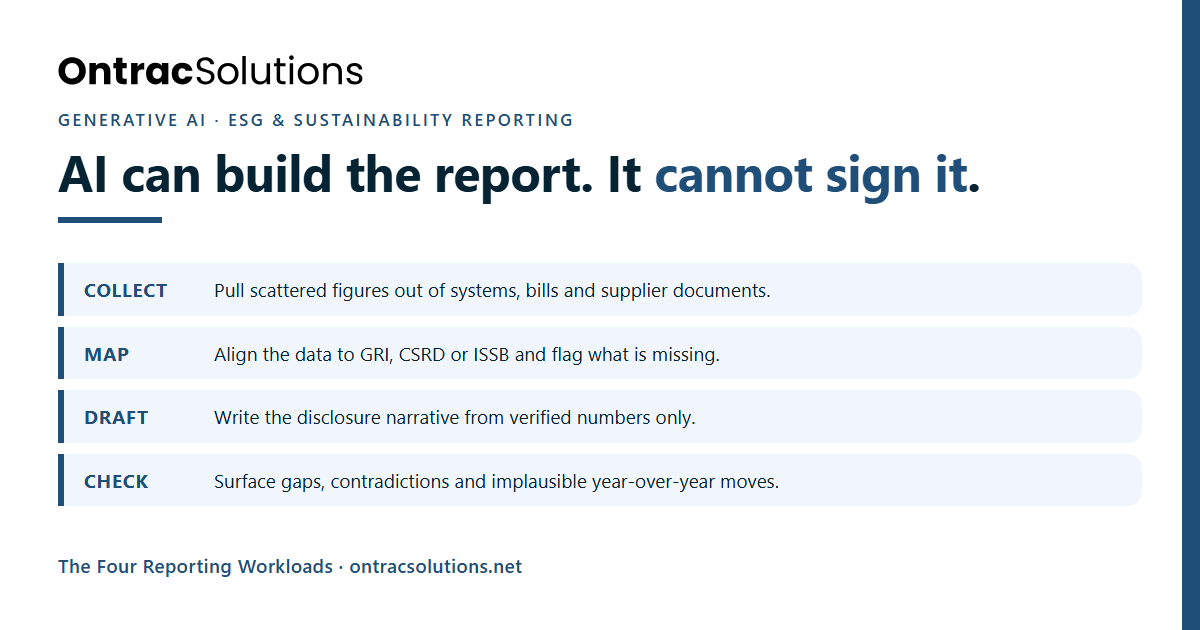
Where does generative AI help with ESG reporting? On four workloads: Collect — pulling scattered data from systems and documents into one place; Map — aligning your data to a reporting framework such as GRI, CSRD or ISSB; Draft — turning verified figures into clear narrative and disclosure text; and Check — flagging gaps, inconsistencies and year-over-year anomalies for a human to resolve. What it must not do is the fifth job: decide materiality or attest to accuracy. Those stay with the people who sign the report.
Why ESG Reporting Is a Data Problem Wearing a Writing Problem's Clothes
Most teams experience ESG reporting as a writing burden, because the deliverable is a long document. The real burden is underneath: the numbers are hard to gather, harder to reconcile, and scattered across systems that were never designed to talk to each other. Energy data sits in facilities, spend data in finance, supplier data in procurement, and headcount and diversity data in HR. Assembling a defensible figure from those sources is the work. Writing it up is the easy last mile.
This matters for AI because generative models are strongest at exactly the last mile and weakest at the part that makes a report trustworthy. Point a model at clean, verified inputs and it will produce excellent disclosure text. Point it at the raw mess and ask it to figure out the truth, and it will produce fluent, confident, unverifiable prose — the worst possible output for a document a regulator might test.
So the sequence is not negotiable: the data has to be reachable and trustworthy before the AI is useful. That is the same groundwork any AI initiative needs, and we wrote it up separately — if your ESG data is scattered and unreconciled, start with building the data foundation first, because no amount of prompting fixes a number nobody trusts.
The Four Reporting Workloads
Each workload is a place where generative AI removes hours of manual effort without removing accountability, because a human still reviews and signs what comes out. Run them in order and the report assembles itself far faster than a manual process, with the judgment left exactly where it belongs.
Workload 1 — Collect: gather the scattered inputs
The first workload is retrieval and consolidation. Generative AI, paired with the right connectors, is good at reading across systems, documents and unstructured sources — utility bills, supplier questionnaires, policy PDFs — and pulling the relevant figures and statements into one structured place. This is the step that eats the most human hours today, done by analysts copying numbers between spreadsheets, and it is the safest to accelerate because every extracted figure is still traceable to its source for verification.
Workload 2 — Map: align data to the framework
The second workload is translation. Your data has to be expressed in the language of a reporting framework, and the frameworks are detailed and evolving — the GRI Standards, the EU's CSRD, and the ISSB's standards each ask for specific disclosures in specific forms. Generative AI is well suited to proposing how a given data point maps to a required disclosure, and to flagging where a framework asks for something you have not collected. The consultant's judgment still confirms the mapping; the AI does the tedious cross-referencing that made the mapping slow.
Workload 3 — Draft: turn verified figures into narrative
The third workload is the one people picture first, and it is genuinely valuable once the inputs are verified. From a table of confirmed figures and a set of approved talking points, generative AI drafts clear, consistent disclosure narrative far faster than a human writing from scratch. The critical constraint is direction of travel: the AI writes from verified data, never inventing or estimating the numbers it describes. A drafting model handed unverified inputs will fill gaps plausibly, which in an ESG report is not a convenience but a liability.
Workload 4 — Check: flag gaps and anomalies for a human
The fourth workload is quality control, and it is where AI quietly earns the most trust. A model can compare this year's figures to last year's, surface a metric that moved implausibly, catch a disclosure the framework requires but the draft omitted, and notice where two sections of the report contradict each other. It does not decide whether an anomaly is an error or a real change — it raises the flag, and a person resolves it. Used this way, AI makes the report more defensible, not less.
| Workload | What AI does | What the human keeps |
|---|---|---|
| Collect | Reads across systems and documents; consolidates traceable figures | Confirming each source is correct and complete |
| Map | Proposes data-to-disclosure mappings against GRI, CSRD, ISSB | Approving the mapping and the framework choice |
| Draft | Writes narrative from verified figures and approved points | Editing tone, claims, and every stated number |
| Check | Flags gaps, anomalies, and contradictions for review | Deciding what each flag means and how to resolve it |
The ESG Reporting Workload Map
A seven-page worksheet version of this article. One page per workload with the four checks to tick, what your team keeps, and the red flag that means you are not ready to automate it yet, plus the sign-off page naming the two jobs no model can own. Built to be filled in by the person who signs the disclosure.
The One Job Generative AI Must Never Own
There is a fifth job, and it belongs entirely to people: deciding what is material and standing behind the result. Materiality — which issues matter enough to report, and how — is a judgment about your business, your stakeholders and your obligations. Attestation is a company putting its name behind a disclosure. Both carry legal and reputational weight, and neither can be delegated to a model that has no accountability and cannot be held responsible for being wrong.
This is not a limitation to work around; it is the point. A generative model that drafts a beautiful report on the wrong material issues has produced a confident, well-written failure. Keeping materiality and attestation human is what lets you safely automate everything around them. The four workloads are the efficiency; the fifth job is the reason the efficiency is safe.
The Three Mistakes That Turn a Time-Saver Into a Liability
Mistake 1: Letting the model estimate a number. When data is missing, a generative model will produce a plausible figure rather than an empty cell, because that is what it is built to do. In an ESG disclosure, a plausible-but-invented number is the single most dangerous output. The rule is absolute: AI writes from verified figures only, and a missing figure stays visibly missing until a human sources it.
Mistake 2: Automating materiality. Asking a model which topics are material outsources the one judgment that defines the whole report. Materiality reflects your business and your stakeholders, not a statistical average of other companies' reports. Let AI summarize inputs to the materiality discussion; never let it make the call.
Mistake 3: Feeding sensitive data to an ungoverned tool. ESG inputs include supplier terms, facility data and sometimes commercially sensitive figures. Pasting them into a consumer AI tool with no data agreement is a governance failure regardless of how good the output is. Use AI inside a governed environment with clear data handling rules, the same discipline any enterprise AI workload requires.
Make ESG reporting faster without making it riskier
Ontrac's generative AI practice and data team build the assembly line for your sustainability report — governed AI on the four workloads, verified data underneath, and materiality and sign-off kept firmly with your people. You get the hours back and keep the accountability.
Talk to our teamIf it helps to work through this with your own numbers in front of you, the whole map is a free seven-page worksheet you can fill in and take into the meeting where the reporting scope gets decided.
Frequently Asked Questions
Can generative AI write our sustainability report?
It can draft most of it, once the underlying figures are verified. Generative AI is strong at collecting scattered inputs, mapping them to a framework, drafting narrative from confirmed numbers, and flagging gaps. It should not decide what is material or stand behind the accuracy of a figure — those stay with the people who sign the report.
Is it safe to use AI for regulated ESG disclosures?
Yes, when it is used on the assembly workloads and inside a governed environment, with a human verifying every figure and owning materiality and attestation. It becomes unsafe when a model is trusted to estimate missing numbers or to make judgments the company is legally accountable for. The safety comes from where you draw the line, not from avoiding AI entirely.
What data do we need before AI can help with ESG reporting?
You need your ESG-relevant data to be reachable and trustworthy: energy, emissions, spend, supplier, and workforce figures consolidated somewhere the AI can access, with sources you can verify. Scattered, unreconciled data is the real blocker, not the AI. Building that foundation first is what makes every later step reliable.
Does generative AI replace a sustainability consultant?
No. It changes what the consultant spends time on. The manual assembly — gathering data, cross-referencing frameworks, drafting boilerplate — shrinks, and the judgment work — materiality, framework strategy, defensibility, sign-off — becomes the focus. The role shifts from document production to verification and decision, which is where its value was always meant to be.
References
Global Reporting Initiative — GRI Standards: globalreporting.org/standards
This article describes general patterns from Ontrac Solutions' consulting work and is not legal, regulatory, or accounting advice. ESG and sustainability reporting obligations depend on your jurisdiction, sector, and size; validate any framework choice and disclosure against the applicable standards and your own advisors.